
As data center construction accelerates across the country, public opposition has hardened amid growing concern about rising energy costs. But a recent Compass Poll from Embold Research of 2,244 registered voters nationwide, fielded May 5-10, 2026, suggests that on-site renewable energy generation may offer a path to building community support for a data center.
Intensifying Opposition
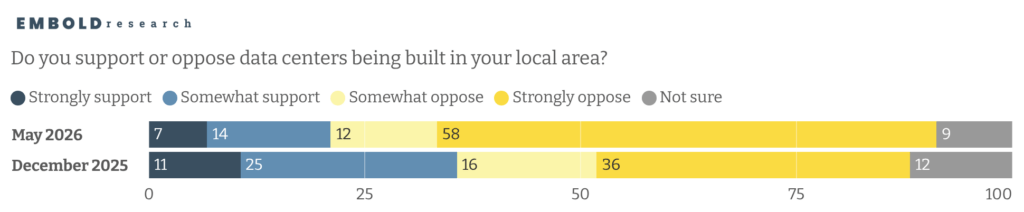
Opposition to local data center construction has risen significantly just over the past six months. In December 2025, just over half of voters (52%) opposed building a data center in their local area, with 36% supportive. By May 2026, total opposition had climbed to 70%, with support falling to just 21%. Perhaps most striking, the share of voters who strongly oppose local construction grew by more than 20 percentage points, rising from 36% to 58%.
Data Centers and the Fear of Higher Energy Bills
Embold Research has documented Americans’ growing anxiety about energy costs extensively, including rising household bills and widespread concern about where prices are headed. Data center construction has only deepened those concerns.
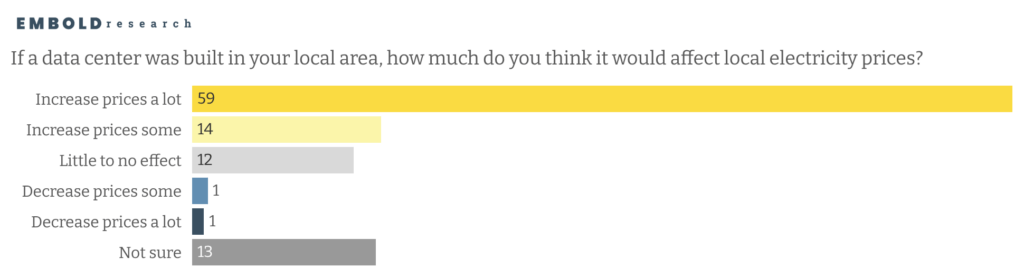
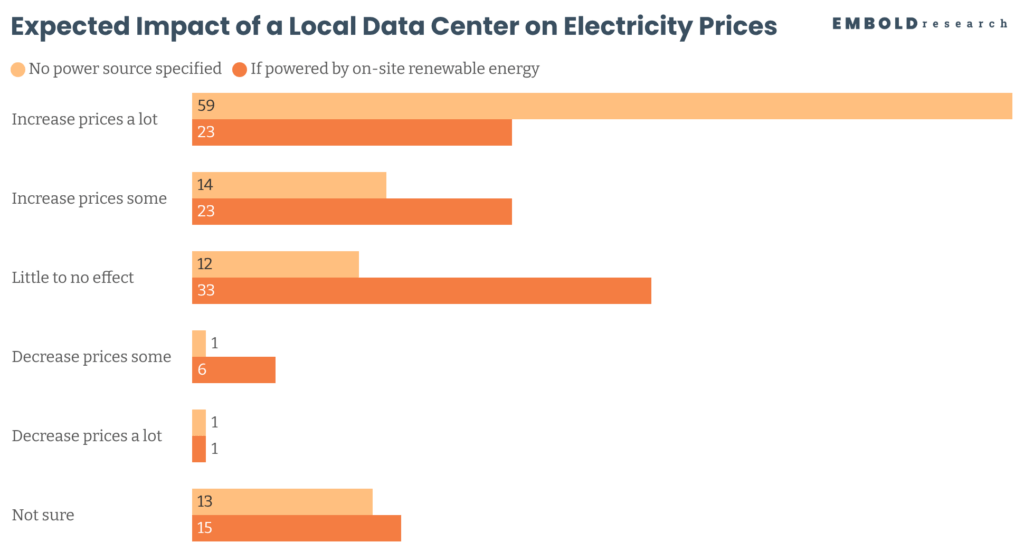
Most voters believe a local data center would make their electricity bills worse. Nearly three in four voters (73%) believe a local data center would increase local electricity prices, including 59% who say prices would rise “a lot.” In contrast, only 12% believe a data center would have minimal impact on their electricity bill, while 13% are unsure how a data center would affect their bill.
On-Site Renewable Generation Can Soften Opposition to Local Data Centers
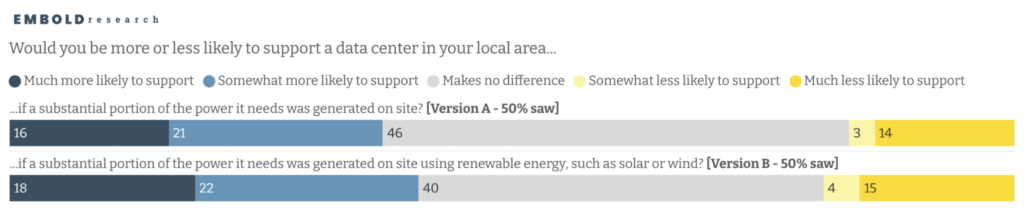
Voters are more receptive to a local data center when it produces its own electricity. Our survey asked respondents whether they would be more or less likely to support a local data center if it generated a substantial portion of its own electricity on-site. Half saw a version of the question that left the energy source unspecified; the other half were told the generation would come from renewable energy such as solar or wind. In both versions, roughly 4 in 10 voters said they would be “more likely” to support a local data center if it produced its own electricity, while a similar share say it would not change their likelihood of supporting one.
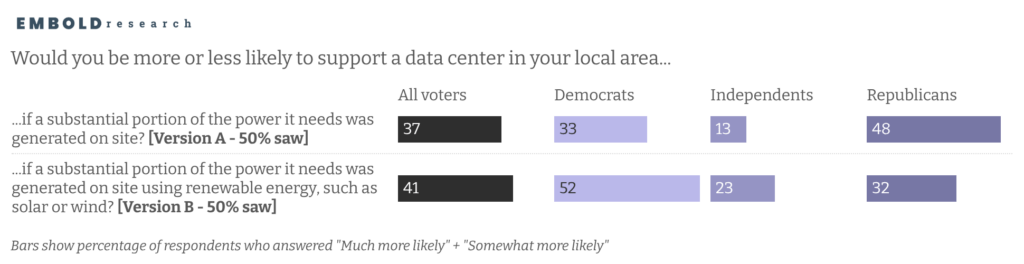
Democrats and Independents are notably more receptive to a local data center when on-site generation comes from renewable sources such as solar or wind, with Democrats jumping from 33% to 52% and Independents from 13% to 23%. Republicans show the opposite pattern, moving more when the energy source is unspecified, at 48% compared to 32% in the renewable version.
On-site renewable generation increases receptivity to a local data center, and it helps assuage concerns about rising electricity prices. When on-site renewable-energy generation is part of the picture, price expectations shift considerably. The share of voters who expect a local data center to increase electricity prices drops from 73% to 46%, driven largely by a sharp decline in those expecting prices to increase “a lot”, from 59% to 23%. Meanwhile, one third of voters now expect on-site renewable generation to have little to no effect on local electricity prices, up from 12%.
Data center opposition is driven by financial anxieties about rising energy costs. On-site renewable energy generation speaks directly to those anxieties, and the data suggests it can soften opposition in a climate where resistance to local data centers has hardened considerably.